
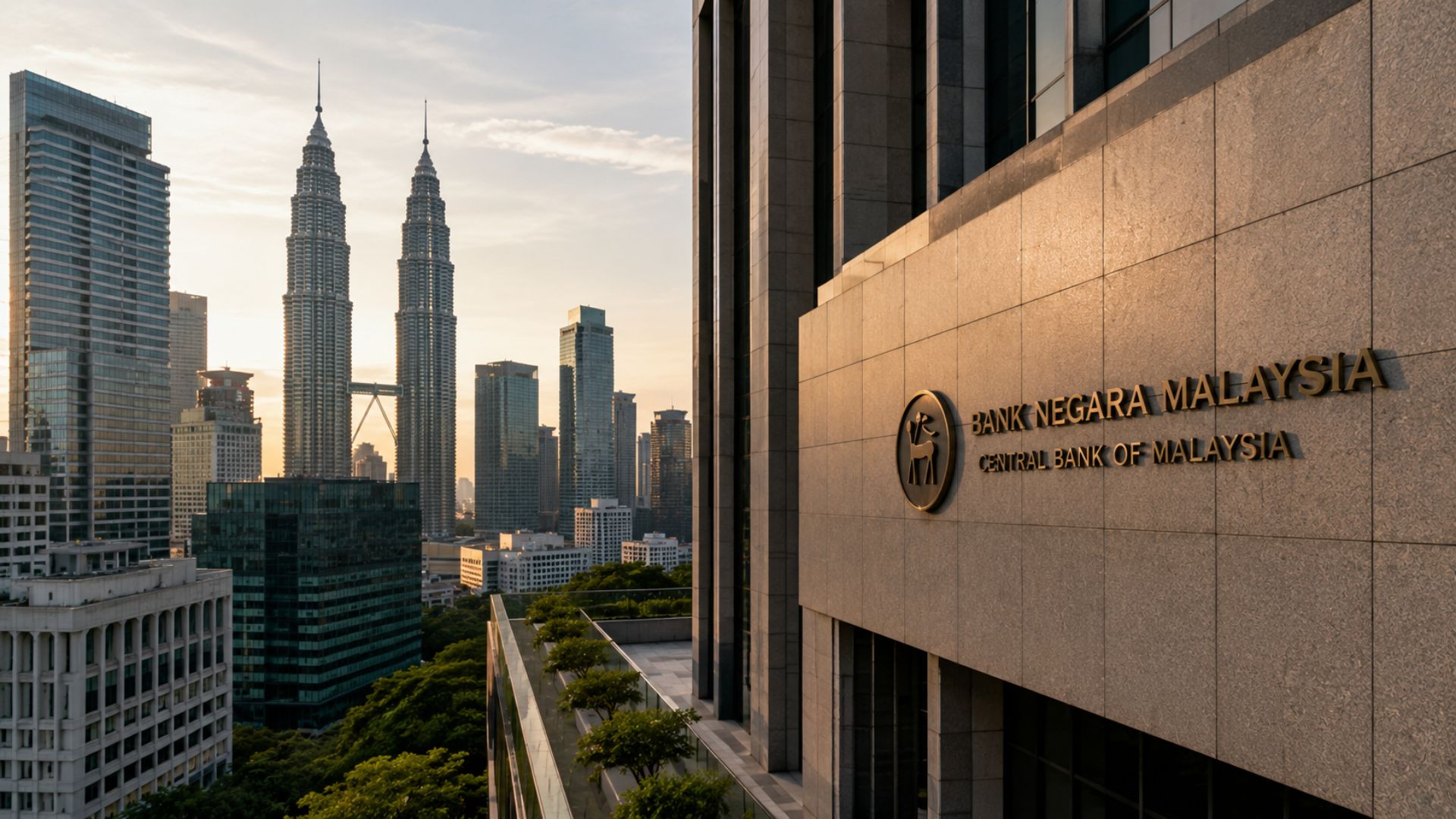







Bank Negara Malaysia and Bank Indonesia formalised a new memorandum of understanding on May 11, 2026, establishing a comprehensive framework for bilateral cooperation across monetary policy, financial stability, payment systems, digitalisation, and financial sector development. The agreement builds on an existing foundation of joint payment infrastructure between the two countries and signals an intention to expand that cooperation into emerging areas of mutual interest.
Key Facts At A Glance
- Bank Negara Malaysia and Bank Indonesia signed a new MoU on May 11, 2026 in a joint statement issued in Kuala Lumpur
- The MoU covers monetary policy, financial stability, macroprudential policy, payment systems and digitalisation, financial sector development, capacity-building, and information sharing
- BNM Governor Dato’ Sri Abdul Rasheed Ghaffour and BI Governor Perry Warjiyo both signed and issued statements affirming the agreement
- The MoU builds on existing bilateral payment infrastructure including the DuitNow-QRIS cross-border QR payment linkage, which launched commercially in May 2023
- The two central banks previously renewed their Local Currency Bilateral Swap Agreement, valued at RM24 billion and IDR 82 trillion, in 2024
- Both governors characterised the agreement as expanding cooperation into emerging areas beyond existing arrangements
- BI Governor Warjiyo described the MoU as more than symbolic, citing the current geopolitical landscape as context for deepening institutional ties
- Malaysia and Indonesia are the two largest economies in ASEAN by population and among the most active bilateral trade partners in the region
A Formal Framework For An Active Bilateral Relationship
Bank Negara Malaysia and Bank Indonesia formalised a new memorandum of understanding on May 11, 2026, setting out a broad cooperative framework covering the full range of central banking functions. The agreement was announced through a joint statement on the same day, with both governors issuing remarks affirming the significance of the arrangement and the intent to deepen it into areas not previously formalised.
BNM Governor Dato’ Sri Abdul Rasheed Ghaffour described the MoU as reaffirming a longstanding partnership while expanding cooperation into emerging areas of mutual interest. BI Governor Perry Warjiyo characterised the agreement as more than a symbolic commitment, noting it reflects the enduring spirit of bilateral institutional cooperation especially against a challenging geopolitical backdrop.
The agreement does not disclose specific timelines, operational targets, or funded programmes. It functions as an overarching framework under which both central banks will coordinate across agreed areas, with the terms of specific initiatives to be developed through subsequent engagement.
Built On Existing Payment Infrastructure
The May 2026 MoU is not the first formal agreement between the two institutions on payments and digitalisation. BNM and BI launched a cross-border QR payment linkage pilot in January 2022, connecting Malaysia’s DuitNow QR system with Indonesia’s Quick Response Code Indonesian Standard, known as QRIS. The linkage moved to full commercial operation in May 2023, enabling consumers in both countries to make instant retail payments at physical and online merchants by scanning either national QR code standard.
The commercial launch expanded the number of participating financial institutions to include non-bank payment providers, with PayNet as the Malaysian operator and the Indonesian Payment System Association coordinating on the Indonesian side. The linkage was designed to run through the Local Currency Settlement Framework, which allows bilateral transactions to be settled directly in ringgit and rupiah without routing through a third currency.
In September 2024, BNM and BI renewed their Local Currency Bilateral Swap Agreement, valued at RM24 billion and IDR 82 trillion, reinforcing the liquidity backstop for local currency transactions between the two countries. At that meeting, both governors also discussed expanding the payment linkage to support person-to-person transfers using mobile numbers or national identification numbers, a capability not yet commercially available at the time.
Positioning Within The Broader ASEAN Payment Architecture
Malaysia and Indonesia are both active participants in the ASEAN Regional Payment Connectivity initiative, which was formalised through a five-central-bank MoU signed in Bali in November 2022 alongside the G20 Leaders’ Summit. That agreement brought together BNM, BI, the Bangko Sentral ng Pilipinas, the Monetary Authority of Singapore, and the Bank of Thailand under a multilateral framework for cross-border QR and fast payment interoperability.
The bilateral MoU signed in May 2026 operates alongside rather than in place of that multilateral framework. Where the regional arrangement governs shared standards and interoperability across five or more markets, the bilateral MoU between BNM and BI provides a dedicated channel for the two central banks to coordinate on issues specific to their relationship, including the DuitNow-QRIS corridor, macroprudential alignment, and areas such as digital asset policy and financial sector development where bilateral engagement may move more quickly than regional consensus.
The two countries share one of the most active bilateral economic relationships in ASEAN, with significant trade, investment, and labour migration flows that create sustained demand for efficient cross-border payment infrastructure. The total value of QRIS cross-border transactions across Malaysia, Singapore, and Thailand reached IDR 1.66 trillion by June 2025, reflecting the scale of usage already running on the existing bilateral infrastructure.
What Comes Next
Both central banks indicated the MoU sets the stage for a more robust and synergistic partnership, without specifying the next concrete deliverable. The areas explicitly named in the MoU, payment systems and digitalisation, are consistent with the trajectory of ongoing discussions around P2P transfer capability between the two countries, which would extend the existing QR linkage into account-to-account real-time transfers using proxy identifiers such as mobile numbers.
Whether the MoU will accelerate that specific initiative or open new cooperation areas such as digital asset regulation, open finance policy, or wholesale CBDC alignment was not disclosed in the joint statement. Publicly available information on the specific programmes to follow from this agreement remains limited at this stage.